Methacholine Challenge Test Vienna, VA
If you experience recurring shortness of breath, wheezing, chest tightness, or chronic cough, but routine breathing tests do not clearly show asthma, a Methacholine Challenge Test may help provide additional information.
At NOVA Pulmonary Critical Care and Sleep Associates in Vienna, VA, our pulmonary specialists evaluate patients with asthma symptoms and other respiratory concerns using pulmonary testing selected according to each patient’s symptoms and medical history.
NOVA Pulmonary Critical Care and Sleep Associates
📍 Vienna Office
124 Park Street SE, Suite 203
Vienna, VA 22180
Map it
📞 571-367-0000
Office Hours:
Mon – Fri: 9:00AM – 5:00PM
Sat & Sun: Closed
Why Is Methacholine Challenge Testing Performed?
Asthma symptoms can vary considerably from one person to another. Some patients have symptoms only occasionally or when exposed to certain triggers. As a result, spirometry may appear normal when the patient is not experiencing symptoms.
A methacholine challenge may be considered when you have symptoms suggestive of asthma but initial testing does not clearly demonstrate airway obstruction.
Symptoms may include:
- Shortness of breath
- Wheezing
- Chest tightness
- Persistent or recurring cough
- Cough triggered by exercise
- Breathing difficulty during physical activity
- Respiratory symptoms triggered by cold air
- Symptoms associated with environmental or seasonal triggers
Your pulmonologist will determine whether this test is appropriate based on your medical history, symptoms, physical examination, and previous pulmonary test results.
Methacholine Challenge Testing for Asthma
Asthma causes inflammation and increased sensitivity of the airways. When exposed to certain triggers, the muscles surrounding the airways may tighten and make breathing more difficult.
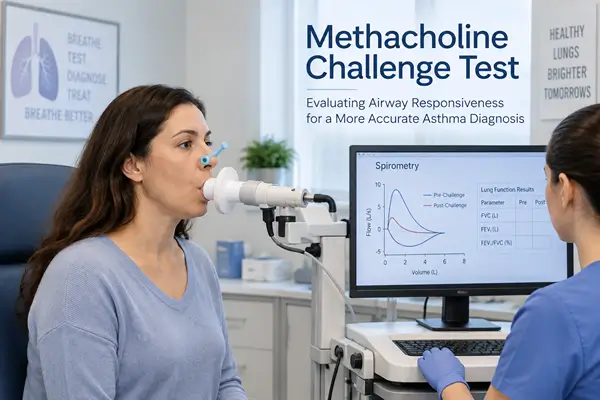
A methacholine challenge evaluates airway responsiveness under controlled conditions.
During testing, spirometry measurements are taken before and after exposure to increasing concentrations of methacholine. Your physician evaluates how your lung function responds.
The results are considered together with your symptoms and other clinical findings. A methacholine challenge is one part of a comprehensive asthma evaluation and is not interpreted in isolation.
What Happens During a Methacholine Challenge Test?
The test generally begins with baseline spirometry to measure your lung function before methacholine is administered.
You will then inhale a carefully controlled amount of methacholine. Afterward, spirometry is repeated to measure whether your airflow has changed.
Depending on your response, additional concentrations may be administered, followed by additional breathing measurements.
During the test, your healthcare team monitors your breathing and symptoms. Testing is stopped according to established clinical criteria or if you develop a significant change in lung function.
A bronchodilator may be administered after testing to help your airways return toward their baseline function.
What Does the Methacholine Challenge Test Measure?
The test primarily evaluates whether your airways become narrower in response to methacholine.
Spirometry is used to measure airflow before and during the challenge. Your pulmonologist evaluates changes in these measurements to determine the degree of airway responsiveness.
The findings can help your physician determine whether asthma is likely to be contributing to your respiratory symptoms or whether other possible causes should be investigated.
Methacholine Challenge for Chronic Cough
A persistent cough can have many possible causes, including asthma, allergies, sinus conditions, reflux, respiratory infections, medications, and other pulmonary conditions.
Some people have asthma in which chronic cough is a prominent symptom, even when they do not experience obvious wheezing.
When asthma is suspected as a possible cause of chronic cough but routine spirometry is inconclusive, a methacholine challenge may provide useful additional information.
Methacholine Challenge for Unexplained Shortness of Breath
Shortness of breath can result from many pulmonary and cardiovascular conditions. In some cases, patients experience recurring breathlessness even though their initial pulmonary function testing appears relatively normal.
If your pulmonologist suspects airway hyperresponsiveness, a methacholine challenge may be considered as part of a broader evaluation.
Depending on your symptoms, other testing may include pulmonary function testing, spirometry, FeNO testing, oxygen evaluation, Six-Minute Walk Testing, or Cardiopulmonary Exercise Testing (CPET).
Preparing for a Methacholine Challenge Test
Your healthcare team will provide specific instructions before your appointment.
Certain medications and other factors can affect airway responsiveness and potentially influence test results. Your instructions may therefore include information about medications, caffeine, smoking or vaping, exercise, and food before testing.
It is important to follow the instructions provided by your healthcare team carefully.
Do not stop or change any prescribed medication unless specifically instructed by your healthcare provider.
Is a Methacholine Challenge the Same as Spirometry?
No. Although spirometry is an important part of the methacholine challenge, the tests serve different purposes.
Spirometry measures how much air you can move in and out of your lungs and how quickly you can exhale.
A Methacholine Challenge Test evaluates how your airways respond after exposure to methacholine. Spirometry measurements are repeated throughout the challenge to identify changes in airflow.
For patients with asthma-like symptoms but normal or inconclusive routine spirometry, this additional information may be helpful.
Methacholine Challenge Testing in Vienna, VA
If you have unexplained wheezing, chronic cough, shortness of breath, chest tightness, or possible asthma, additional pulmonary testing may help determine the cause of your symptoms.
NOVA Pulmonary Critical Care and Sleep Associates provides comprehensive pulmonary evaluation and respiratory testing for patients in Vienna, Tysons, McLean, Fairfax, and surrounding Northern Virginia communities.
Contact our Vienna, VA office to schedule a pulmonary evaluation and determine whether a Methacholine Challenge Test is appropriate for you.
Directions & Parking Information
Our Vienna office is located on Park Street SE near the Vienna Community Center and historic downtown Vienna.
Free parking available near the building
Elevator access to Suite 203
Easily accessible from Route 123 and I-66
Minutes from Tysons Corner
If you need assistance locating our office, please call and our staff will guide you.
Frequently Asked Questions
What is a Methacholine Challenge Test?
A Methacholine Challenge Test is a specialized breathing test used to evaluate airway responsiveness. During the test, controlled amounts of methacholine are inhaled and spirometry is performed to measure how the airways respond.
Why would my pulmonologist recommend a methacholine challenge?
Your pulmonologist may consider the test if you have symptoms such as wheezing, chronic cough, chest tightness, or shortness of breath that suggest asthma but routine breathing tests have not provided a clear answer.
Can I have asthma even if my spirometry is normal?
Yes. Asthma symptoms and airway narrowing can vary over time, so some people may have normal spirometry when they are not experiencing symptoms. Additional testing may be appropriate when asthma is still suspected.
Is a methacholine challenge the same as a pulmonary function test?
No. Spirometry and other pulmonary function tests evaluate different aspects of lung function. A methacholine challenge specifically evaluates how responsive your airways are after exposure to methacholine.
Can a methacholine challenge help evaluate chronic cough?
It may be useful when asthma is suspected as a possible cause of chronic cough but routine spirometry has not clearly demonstrated airway obstruction.
What happens if my breathing changes during the test?
Your breathing and lung function are monitored throughout the test. Testing is stopped according to clinical criteria, and a bronchodilator may be given afterward to help return your airways toward their baseline function.
Do I need to stop my inhalers before a Methacholine Challenge Test?
Some medications can affect test results, but you should not stop any medication on your own. Your healthcare team will provide specific instructions about which medications, if any, should be temporarily withheld before testing.
Office Locations
Conveniently located near you in Dulles, Leesburg, (Loudoun County) and Vienna, (Fairfax County), VA
NOVA Pulmonary – Dulles
24430 Stone Springs Boulevard
Suite 550
Dulles, VA 20166
NOVA Pulmonary – Lansdowne
19415 Deerfield Avenue
Suite 301
Lansdowne, VA 20176
NOVA Pulmonary Critical Care and Sleep Associates is committed to providing excellent care in all aspects of Pulmonary Medicine and Sleep Disorders. With offices located in Lansdowne and Dulles, South Riding, we offer care for the entire Northern Virginia region, serving locations from Chantilly, Fairfax, Vienna, Centreville, Manassas, Gainesville to Reston, Sterling, Leesburg, Ashburn, Brambleton, Purcellville and more.
Meet the team at NOVA Pulmonary Critical Care and Sleep Associates

Dr. Aditya N Dubey, M.D, F.C.C.P. – Founder
Specialty:
Pulmonary, Critical Care and Sleep Medicine
Board Certified by American Board of Internal Medicine in the Subspecialities of Pulmonary Medicine, Critical Care Medicine and Sleep Medicine. Learn more about Dr. Dubey

Dr. Petra Thomas, M.D.
Specialty:
Pulmonary Medicine
Board Certified by American Board of Internal Medicine in the Subspecialities of Pulmonary Medicine. Learn more about Dr. Thomas

Dr. Esha Kapania, M.D.
Specialty:
Pulmonary Medicine
Board Certified by American Board of Internal Medicine in the Subspecialities of Pulmonary Medicine. Learn more about Dr. Kapania

Dr. Arman Murabia, M.D.
Specialty:
Pulmonary, Critical Care and Sleep Medicine
Board Certified by American Board of Internal Medicine in the Subspecialities of Pulmonary Medicine, Critical Care Medicine and Sleep Medicine. Learn more about Dr. Murabia

Dr. Zara Martirosyan, MD
Specialty:
Sleep Medicine & Internal Medicine Specialist
Board-certified physician in both Sleep medicine and Internal medicine. Learn more about Dr. Martirosyan

Rebekah Lee, AGNP-C, Lead APP
Nurse Practitioner. Learn more about Rebekah Lee

Paulos Abebe PA-C
Physician Assistant Learn more about Paulos Abebe PA-C

Katie Cameron, PA
Physician Assistant Learn more about Katie Cameron, PA-C