Lung Biopsy Evaluation Vienna, VA
An abnormal spot on a chest X-ray or CT scan can raise many questions. If imaging identifies a lung nodule, mass, unusual area of lung tissue, or enlarged lymph node, your physician may recommend further evaluation to determine what is causing the abnormality.
In some cases, obtaining a small tissue sample through a lung biopsy can provide important diagnostic information.
At NOVA Pulmonary Critical Care and Sleep Associates, our pulmonary specialists provide lung biopsy evaluations in Vienna, VA. We review your imaging, symptoms, medical history, and other test results to determine whether a biopsy may be appropriate and which diagnostic approach should be considered.
A recommendation for a lung biopsy does not necessarily mean that you have lung cancer. Lung abnormalities can have many possible causes, including infections, inflammation, scar tissue, autoimmune disease, and benign growths.
NOVA Pulmonary Critical Care and Sleep Associates
📍 Vienna Office
124 Park Street SE, Suite 203
Vienna, VA 22180
Map it
📞 571-367-0000
Office Hours:
Mon – Fri: 9:00AM – 5:00PM
Sat & Sun: Closed
What Is a Lung Biopsy?
A lung biopsy is a procedure used to obtain a small sample of tissue from the lung, airway, or nearby lymph nodes.
The tissue is examined in a laboratory by a pathologist. Depending on the reason for the biopsy, the sample may be evaluated for abnormal cells, inflammation, infection, cancer, or other conditions.
There are several ways lung tissue can be obtained. The appropriate approach depends largely on where the abnormality is located, its size and appearance, your overall health, and what your physicians are trying to diagnose.
Why Might a Lung Biopsy Be Recommended?
A pulmonologist may consider biopsy or additional diagnostic evaluation after an abnormality is identified on chest imaging.
Reasons for evaluation may include:
- A lung nodule that has suspicious characteristics
- A lung mass
- An abnormal area seen on a CT scan
- Enlarged lymph nodes in the chest
- Unexplained changes in lung tissue
- Possible lung cancer
- Persistent or unusual pulmonary infection
- Interstitial or inflammatory lung disease
- An abnormality that has changed on follow-up imaging
- A pulmonary condition that cannot be diagnosed through imaging and laboratory testing alone
Not every abnormal finding requires a biopsy.
Some lung nodules, for example, can be monitored with follow-up CT scans depending on their size, appearance, growth pattern, and the patient’s individual risk factors.
Does a Lung Nodule Always Need a Biopsy?
No.
Lung nodules are relatively common, and many are benign. A nodule may represent an old infection, scar tissue, inflammation, or another noncancerous condition.
Before recommending a biopsy, your pulmonologist may consider factors such as:
- Size of the nodule
- Shape and borders
- Location within the lung
- Whether it is solid, partially solid, or ground-glass in appearance
- Changes compared with previous imaging
- Your age
- Smoking history
- Previous cancer history
- Family and medical history
- Other individual risk factors
Depending on these findings, the next step might be continued imaging surveillance, additional imaging, bronchoscopy, biopsy, or another diagnostic procedure.
Types of Lung Biopsy
There is no single biopsy technique that is appropriate for every lung abnormality.
Your pulmonologist can help determine which approach may provide the necessary information while considering the location of the abnormality and your individual circumstances.
Bronchoscopy With Biopsy
During bronchoscopy, a thin, flexible instrument containing a camera is passed through the mouth or nose and into the airways.
Small instruments can be passed through the bronchoscope to collect tissue samples when medically appropriate.
Bronchoscopy may be particularly useful when the area requiring evaluation can be approached through the airways.
EBUS-Guided Biopsy
Endobronchial ultrasound (EBUS) combines bronchoscopy with ultrasound technology.
The ultrasound allows the pulmonologist to examine structures located next to the airways, including certain lymph nodes. A needle can then be guided to the appropriate area to obtain tissue samples.
CT-Guided Needle Biopsy
Some abnormalities are more accessible from outside the lung than through the airways.
In these situations, imaging may be used to guide a needle through the chest wall and into the abnormal area to obtain a tissue sample.
Whether this approach is appropriate depends on the size and location of the abnormality as well as other patient-specific factors.
Surgical Lung Biopsy
In selected cases, a larger tissue sample may be required.
A surgical biopsy may be considered when less-invasive approaches are unlikely to provide sufficient information or when previous testing has not established a diagnosis.
Your pulmonary specialist can discuss whether referral for a surgical evaluation is appropriate.
Lung Biopsy and Lung Cancer Evaluation
One reason a biopsy may be performed is to determine whether an abnormal lung nodule or mass contains cancer cells.
However, imaging alone cannot always determine whether an abnormality is cancerous.
When tissue sampling is appropriate, laboratory examination can help determine the nature of the abnormality and provide information that may guide additional treatment or testing.
If you have been referred for biopsy because of a suspicious nodule or mass, remember that the need for additional testing does not itself establish a cancer diagnosis.
Lung Biopsy for Enlarged Lymph Nodes
Abnormal or enlarged lymph nodes within the chest may sometimes require further evaluation.
Depending on their location, EBUS-guided sampling may allow a pulmonologist to obtain tissue from certain lymph nodes without conventional surgery.
Lymph-node sampling may help evaluate suspected malignancy as well as certain inflammatory or infectious conditions.
Lung Biopsy for Interstitial Lung Disease
A biopsy is not required for every patient with interstitial lung disease (ILD).
High-resolution CT imaging, pulmonary function testing, blood tests, medical history, and other clinical information may sometimes provide sufficient information to establish or strongly support a diagnosis.
In selected cases where the cause remains uncertain, tissue sampling may be considered.
The decision depends on whether obtaining tissue is likely to provide information that would meaningfully affect diagnosis or treatment.
What Happens During a Lung Biopsy Evaluation?
Your first step is generally a pulmonary consultation rather than immediately undergoing a procedure.
Your pulmonologist may review:
- Your chest CT scans and X-rays
- Previous imaging for comparison
- The location and characteristics of the abnormality
- Pulmonary symptoms
- Smoking and occupational history
- Previous infections
- Cancer history
- Current medications
- Blood-thinning medications
- Pulmonary function
- Other medical conditions
The goal is to determine whether tissue sampling is necessary and, if so, which approach is most appropriate.
This distinction is important because sometimes the best next step is not a biopsy at all.
Preparing for a Lung Biopsy
Preparation varies considerably depending on the type of procedure being considered.
Your healthcare team may provide instructions concerning food and drink, medications, transportation, and other preparation.
It is particularly important to tell your physician about:
- Blood-thinning medications
- Aspirin or other medications that affect bleeding
- Medication allergies
- Previous reactions to anesthesia or sedation
- Heart or lung conditions
- Pregnancy or possible pregnancy
- Previous problems with medical procedures
Do not stop prescription medications unless your healthcare provider specifically instructs you to do so.
Are There Risks With Lung Biopsy?
All invasive procedures have potential risks, and those risks vary depending on the type of biopsy performed.
Possible complications can include:
- Bleeding
- Infection
- Pneumothorax, or collapsed lung
- Temporary changes in oxygen levels
- Discomfort or coughing
- Reactions to sedation or anesthesia
Your physician will discuss the specific benefits and risks associated with the procedure being considered.
What Happens After a Lung Biopsy?
What to expect afterward depends on the biopsy technique.
Some procedures are performed on an outpatient basis, while others may require additional monitoring or hospital care.
If tissue has been collected, it is sent to a laboratory for analysis. Results are generally not immediate because the tissue must be carefully processed and examined. Certain samples may require additional specialized testing.
Your physician will review the pathology results with you and discuss what they mean and whether additional testing, monitoring, or treatment is recommended.
When Should You See a Pulmonologist?
Consider a pulmonary evaluation if you have:
- A newly discovered lung nodule
- An abnormal chest CT or X-ray
- A lung mass
- Enlarged lymph nodes in the chest
- An abnormality that has changed on follow-up imaging
- Persistent unexplained respiratory symptoms
- A suspected inflammatory or interstitial lung condition
- Been told that you may need bronchoscopy or lung biopsy
- Been referred for further evaluation of possible lung cancer
The purpose of the consultation is to determine the most appropriate next step—not simply to perform a biopsy.
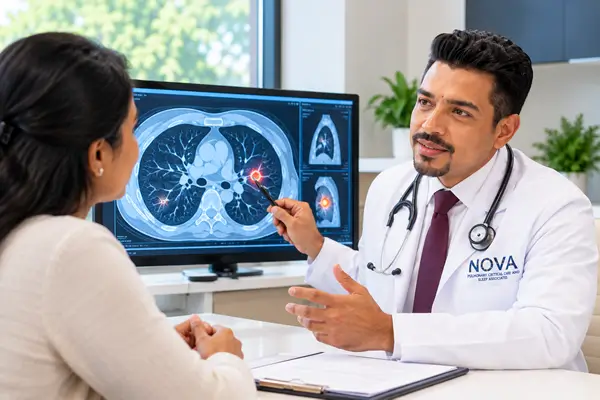
Lung Biopsy Evaluation and Pulmonary Care in Vienna, VA
NOVA Pulmonary Critical Care and Sleep Associates provides comprehensive pulmonary evaluation for patients with abnormal chest imaging, lung nodules, lung masses, enlarged lymph nodes, interstitial lung disease, and other complex respiratory conditions.
For patients with an abnormal lung finding, our pulmonary specialists can review existing imaging and testing and help determine whether continued monitoring, additional imaging, bronchoscopy, tissue sampling, or another diagnostic approach should be considered.
Schedule an Appointment for Lung Biopsy in Vienna, VA
If an abnormal chest X-ray or CT scan has raised concern about a lung nodule, mass, lymph node, or other pulmonary abnormality, our specialists can review your findings and help determine the appropriate next step.
NOVA Pulmonary Critical Care and Sleep Associates
124 Park Street SE, Suite 203
Vienna, VA 22180
Phone: 571-367-0000
Directions & Parking Information
Our Vienna office is located on Park Street SE near the Vienna Community Center and historic downtown Vienna.
Free parking available near the building
Elevator access to Suite 203
Easily accessible from Route 123 and I-66
Minutes from Tysons Corner
If you need assistance locating our office, please call and our staff will guide you.
Frequently Asked Questions About Lung Biopsy
Does a lung biopsy mean my doctor thinks I have cancer?
Not necessarily. Lung biopsies can be used to investigate cancer, but they may also help diagnose infections, inflammatory conditions, interstitial lung diseases, and other abnormalities. A recommendation for biopsy does not itself mean that cancer is present.
Does every lung nodule need a biopsy?
No. Many lung nodules can be monitored with follow-up imaging. Whether a biopsy should be considered depends on factors such as the nodule’s size, appearance, growth, location, and your individual risk factors.
Can a lung biopsy be performed during bronchoscopy?
Yes. When medically appropriate, small instruments can be passed through a bronchoscope to collect tissue samples from certain areas of the lungs or airways.
What is an EBUS biopsy?
Endobronchial ultrasound, or EBUS, combines bronchoscopy with ultrasound. It can help the physician see certain structures next to the airways and guide tissue sampling, including sampling of certain lymph nodes.
How long does it take to get lung biopsy results?
The timing varies depending on the type of tissue obtained and the laboratory tests required. Some samples require additional staining, cultures, molecular testing, or other specialized analysis, so your physician will tell you when to expect your particular results.
Is a lung biopsy painful?
The experience varies depending on the biopsy technique. Local anesthetic, sedation, or anesthesia may be used depending on the procedure. Your healthcare team will explain how discomfort is managed for the particular biopsy being considered.
Who decides which type of lung biopsy I need?
The appropriate biopsy method is determined based on the location and characteristics of the abnormality, your medical history, imaging findings, overall health, and the information your physicians need to obtain.
Office Locations
Conveniently located near you in Dulles, Leesburg, (Loudoun County) and Vienna, (Fairfax County), VA
NOVA Pulmonary – Dulles
24430 Stone Springs Boulevard
Suite 550
Dulles, VA 20166
NOVA Pulmonary – Lansdowne
19415 Deerfield Avenue
Suite 301
Lansdowne, VA 20176
NOVA Pulmonary Critical Care and Sleep Associates is committed to providing excellent care in all aspects of Pulmonary Medicine and Sleep Disorders. With offices located in Lansdowne and Dulles, South Riding, we offer care for the entire Northern Virginia region, serving locations from Chantilly, Fairfax, Vienna, Centreville, Manassas, Gainesville to Reston, Sterling, Leesburg, Ashburn, Brambleton, Purcellville and more.
Meet the team at NOVA Pulmonary Critical Care and Sleep Associates

Dr. Aditya N Dubey, M.D, F.C.C.P. – Founder
Specialty:
Pulmonary, Critical Care and Sleep Medicine
Board Certified by American Board of Internal Medicine in the Subspecialities of Pulmonary Medicine, Critical Care Medicine and Sleep Medicine. Learn more about Dr. Dubey

Dr. Petra Thomas, M.D.
Specialty:
Pulmonary Medicine
Board Certified by American Board of Internal Medicine in the Subspecialities of Pulmonary Medicine. Learn more about Dr. Thomas

Dr. Esha Kapania, M.D.
Specialty:
Pulmonary Medicine
Board Certified by American Board of Internal Medicine in the Subspecialities of Pulmonary Medicine. Learn more about Dr. Kapania

Dr. Arman Murabia, M.D.
Specialty:
Pulmonary, Critical Care and Sleep Medicine
Board Certified by American Board of Internal Medicine in the Subspecialities of Pulmonary Medicine, Critical Care Medicine and Sleep Medicine. Learn more about Dr. Murabia

Dr. Zara Martirosyan, MD
Specialty:
Sleep Medicine & Internal Medicine Specialist
Board-certified physician in both Sleep medicine and Internal medicine. Learn more about Dr. Martirosyan

Rebekah Lee, AGNP-C, Lead APP
Nurse Practitioner. Learn more about Rebekah Lee

Paulos Abebe PA-C
Physician Assistant Learn more about Paulos Abebe PA-C

Katie Cameron, PA
Physician Assistant Learn more about Katie Cameron, PA-C