Bronchoscopy in Vienna VA
Bronchoscopy is a procedure that allows a pulmonologist to examine the airways and lungs using a thin, flexible tube equipped with a small camera. It can help physicians investigate abnormal chest imaging, persistent respiratory symptoms, recurrent infections, bleeding in the airways, and other pulmonary concerns. During the procedure, samples of mucus, fluid, cells, or lung tissue may also be collected when medically appropriate.
At NOVA Pulmonary Critical Care and Sleep Associates, our pulmonary specialists provide bronchoscopy evaluation and care for patients in Vienna, VA. When bronchoscopy is recommended, we help patients understand why the procedure may be needed, what to expect, and how the findings can assist in diagnosing or managing a pulmonary condition.
NOVA Pulmonary Critical Care and Sleep Associates
📍 Vienna Office
124 Park Street SE, Suite 203
Vienna, VA 22180
Map it
📞 571-367-0000
Office Hours:
Mon – Fri: 9:00AM – 5:00PM
Sat & Sun: Closed
What Is a Bronchoscopy?
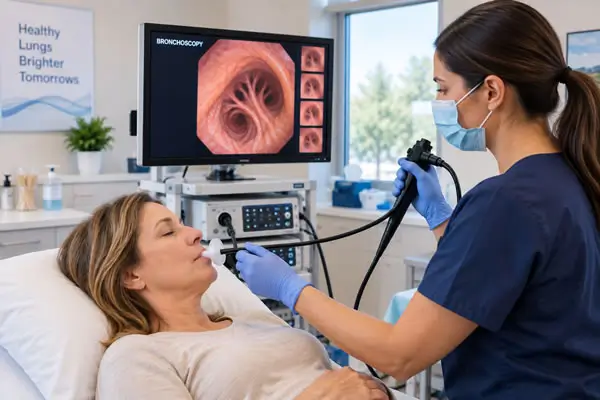
Bronchoscopy allows a physician to directly examine the trachea and bronchial tubes that carry air into the lungs. A bronchoscope contains a light and camera that transmit images of the airways to a monitor.
Flexible bronchoscopy is commonly performed through the mouth or nose while the patient receives medication for comfort. Depending on the reason for the procedure, the physician may simply examine the airways or collect samples for laboratory or pathology testing.
Why Is Bronchoscopy Performed?
Bronchoscopy may be recommended when symptoms, imaging studies, or other pulmonary tests indicate that the airways or lungs need to be examined more closely.
Reasons for bronchoscopy may include:
✓ Abnormal chest X-ray or CT scan
✓ Persistent or unexplained cough
✓ Recurrent pneumonia or pulmonary infections
✓ Coughing up blood
✓ Unexplained shortness of breath
✓ Abnormal lung findings
✓ Suspected airway obstruction
✓ Lung nodules or masses requiring further evaluation
✓ Collection of respiratory samples
✓ Evaluation of inflammation or infection
✓ Removal of mucus plugs or foreign material in selected cases
The reason for bronchoscopy and the type of testing performed during the procedure will depend on each patient’s individual circumstances.
Bronchoscopy for an Abnormal Chest X-Ray or CT Scan
An abnormal chest X-ray or CT scan does not necessarily indicate a serious lung condition. However, certain findings may require additional investigation.
Bronchoscopy may be considered when imaging shows an abnormality involving the airways or lungs that cannot be fully evaluated through imaging alone.
The procedure allows the pulmonologist to directly examine portions of the airway and, when appropriate, obtain samples that can be evaluated in a laboratory.
Bronchoscopy for Recurrent Pneumonia and Lung Infections
Patients who experience repeated episodes of pneumonia or persistent pulmonary infections may sometimes benefit from bronchoscopy as part of a broader evaluation.
For example, a pulmonologist may use bronchoscopy to look for an airway obstruction, collect respiratory samples, or investigate why an infection repeatedly occurs in a particular area of the lung.
Bronchoscopy is not necessary for every case of pneumonia. Your pulmonologist will determine whether the procedure is appropriate based on your symptoms, imaging, medical history, and previous testing.
Bronchoscopy for Persistent Cough
Most coughs do not require bronchoscopy. However, when a cough persists and its cause remains unclear after an appropriate evaluation, a pulmonologist may consider additional diagnostic testing.
Bronchoscopy can provide a direct view of the airways and may help identify inflammation, narrowing, an obstruction, or another abnormality that may not be apparent through routine testing alone. Persistent unexplained cough is among the diagnostic reasons bronchoscopy may be considered.
Bronchoscopy for Coughing Up Blood
Coughing up blood, also called hemoptysis, can have many potential causes. Depending on the amount of bleeding and the patient’s overall condition, it may require prompt medical evaluation.
In selected patients, bronchoscopy may help physicians identify where bleeding is coming from and evaluate the airways for an underlying cause.
Significant or ongoing coughing up of blood, particularly when accompanied by breathing difficulty, chest pain, dizziness, or other concerning symptoms, should receive prompt medical attention.
Can Samples Be Collected During Bronchoscopy?
Yes. One of the advantages of bronchoscopy is that physicians can examine the airways and collect samples during the same procedure when needed.
Depending on the clinical situation, samples may include:
✓ Bronchial washings
✓ Mucus or respiratory secretions
✓ Cells
✓ Small tissue biopsies
✓ Samples for bacterial, fungal, or other microbiological testing
The type of sample collected depends on what your pulmonologist is investigating. Bronchoscopy’s working channel allows physicians to collect tissue and other samples for diagnostic testing.
What Happens During a Bronchoscopy?
Before the procedure, your healthcare team will review your medical history, medications, allergies, and other relevant health information.
An intravenous line may be placed to administer medication. Your blood pressure, heart rate, and oxygen level are typically monitored throughout the procedure.
Medication is generally used to help keep you comfortable, and numbing medication may be applied to the throat or airway. The bronchoscope is then carefully passed through the mouth or nose and into the airways.
Your pulmonologist examines the airways and performs any additional sampling or procedures that have been planned. Flexible bronchoscopy commonly takes approximately 30 to 45 minutes, although the duration can vary depending on what needs to be done.
How Do I Prepare for Bronchoscopy?
Your medical team will provide specific instructions before your procedure.
Preparation may include:
✓ Avoiding food and liquids for a specified period before the procedure
✓ Reviewing prescription and over-the-counter medications
✓ Discussing blood-thinning medications with your physician
✓ Informing your doctor about medication allergies
✓ Discussing previous problems with anesthesia or sedation
✓ Arranging transportation home after the procedure
Do not stop prescription medications unless your healthcare provider specifically instructs you to do so.
Because sedation is commonly used, patients generally need someone else to drive them home after the procedure.
What Happens After Bronchoscopy?
After bronchoscopy, patients are monitored while the effects of sedation wear off.
A mild sore throat, hoarseness, or cough can occur following the procedure. Your healthcare team will provide instructions about when you can resume eating, drinking, medications, and normal activities.
If samples or biopsies were collected, those results may take several days or longer depending on the type of laboratory testing required.
Is Bronchoscopy Safe?
Bronchoscopy is generally considered a safe procedure, but as with any medical procedure, complications are possible.
Potential risks can include:
✓ Bleeding, particularly when a biopsy is performed
✓ Infection
✓ Temporary decrease in oxygen levels
✓ Airway irritation or coughing
✓ Reaction to sedation or anesthesia
✓ Pneumothorax, or collapsed lung, in certain circumstances
Your physician will discuss the potential benefits and risks based on your health and the specific type of bronchoscopy being considered.
When Is Bronchoscopy Considered?
Bronchoscopy allows a pulmonologist to examine the airways using a thin, flexible instrument equipped with a camera.
It is not necessary for every patient with recurrent pneumonia. However, bronchoscopy may be considered in selected cases, such as when an airway obstruction is suspected, an infection is difficult to identify, or additional respiratory samples are needed.
Your pulmonologist will determine whether bronchoscopy is appropriate based on your imaging findings, symptoms, and medical history.
When Should I Contact My Doctor After Bronchoscopy?
Your healthcare team will provide specific post-procedure instructions. Contact your healthcare provider if you develop concerning symptoms after bronchoscopy, such as worsening difficulty breathing, chest pain, persistent fever, significant coughing up of blood, or symptoms that are becoming worse rather than improving.
Bronchoscopy and Lung Biopsy
Bronchoscopy may sometimes be used to obtain small tissue samples from the lungs or airways.
A biopsy may be recommended when physicians need additional information about an abnormal area identified through imaging or other testing. Tissue collected during bronchoscopy can then be examined by a laboratory to help determine the nature of the abnormality.
Not every bronchoscopy requires a biopsy.
Bronchoscopy and EBUS
Endobronchial ultrasound, commonly called EBUS, is a specialized form of bronchoscopy that combines a bronchoscope with ultrasound technology.
EBUS can help physicians examine structures next to the airways, including lymph nodes, and can be used to guide the collection of tissue samples. It may be used in the evaluation of certain infections, inflammatory conditions, abnormal lymph nodes, or suspected cancer.
Whether conventional bronchoscopy, EBUS, or another diagnostic approach is appropriate depends on the location and nature of the abnormality being evaluated.
When Should You See a Pulmonologist?
A pulmonary consultation may be appropriate if you have:
✓ An abnormal chest X-ray or CT scan
✓ Recurrent pneumonia
✓ Persistent or unexplained cough
✓ Coughing up blood
✓ Unexplained shortness of breath
✓ A suspected airway abnormality
✓ A lung nodule or other abnormal imaging finding
✓ A pulmonary infection that has been difficult to diagnose
✓ Been referred for consideration of bronchoscopy
Your pulmonologist can review your symptoms and previous testing to determine whether bronchoscopy or another diagnostic procedure may be appropriate.
Bronchoscopy Evaluation in Vienna, Virginia
NOVA Pulmonary Critical Care and Sleep Associates provides comprehensive pulmonary care for patients in Vienna and surrounding Northern Virginia communities.
Our pulmonary specialists evaluate patients with abnormal chest imaging, recurrent pneumonia, lung nodules, chronic cough, bronchiectasis, emphysema, COPD, pulmonary fibrosis, interstitial lung disease, pleural effusion, pulmonary hypertension, and other respiratory conditions.
When bronchoscopy is medically appropriate, the procedure can provide valuable information that complements chest imaging, pulmonary function testing, laboratory studies, and other diagnostic evaluations.
Schedule a Bronchoscopy Evaluation in Vienna, VA
If you have been referred for bronchoscopy or have a pulmonary condition that may require further diagnostic evaluation, our pulmonary specialists can review your symptoms, imaging studies, and medical history to determine the appropriate next step.
Contact NOVA Pulmonary Critical Care and Sleep Associates to schedule a bronchoscopy evaluation in Vienna, VA.
Directions & Parking Information
Our Vienna office is located on Park Street SE near the Vienna Community Center and historic downtown Vienna.
Free parking available near the building
Elevator access to Suite 203
Easily accessible from Route 123 and I-66
Minutes from Tysons Corner
If you need assistance locating our office, please call and our staff will guide you.
Frequently Asked Questions
What is bronchoscopy used to diagnose?
Bronchoscopy can help evaluate abnormal chest imaging, persistent cough, recurrent pulmonary infections, coughing up blood, airway abnormalities, and other lung conditions. It can also be used to collect respiratory or tissue samples when necessary.
Is bronchoscopy painful?
Medication and local numbing agents are commonly used to help keep patients comfortable during flexible bronchoscopy. Patients may experience a mild sore throat or cough afterward.
How long does a bronchoscopy take?
A standard flexible bronchoscopy often takes approximately 30 to 45 minutes, although the duration can vary depending on the procedures or sampling being performed.
Can a biopsy be performed during bronchoscopy?
Yes. When medically appropriate, instruments can be passed through the bronchoscope to collect small tissue samples for laboratory examination.
Can bronchoscopy help diagnose a lung infection?
Yes. Bronchoscopy can sometimes be used to collect respiratory samples that are tested for bacteria, fungi, or other microorganisms when an infection requires further investigation.
Do I need someone to drive me home after bronchoscopy?
If sedation is used, you generally will not be permitted to drive afterward and should arrange for someone to take you home.
Is bronchoscopy an outpatient procedure?
Flexible bronchoscopy is commonly performed as an outpatient procedure, allowing many patients to return home after an appropriate recovery and observation period.
Where can I get evaluated for bronchoscopy in Vienna, VA?
NOVA Pulmonary Critical Care and Sleep Associates provides bronchoscopy evaluation and comprehensive pulmonary care for patients in Vienna, VA and surrounding Northern Virginia communities.
Office Locations
Conveniently located near you in Dulles, Leesburg, (Loudoun County) and Vienna, (Fairfax County), VA
NOVA Pulmonary – Dulles
24430 Stone Springs Boulevard
Suite 550
Dulles, VA 20166
NOVA Pulmonary – Lansdowne
19415 Deerfield Avenue
Suite 301
Lansdowne, VA 20176
NOVA Pulmonary Critical Care and Sleep Associates is committed to providing excellent care in all aspects of Pulmonary Medicine and Sleep Disorders. With offices located in Lansdowne and Dulles, South Riding, we offer care for the entire Northern Virginia region, serving locations from Chantilly, Fairfax, Vienna, Centreville, Manassas, Gainesville to Reston, Sterling, Leesburg, Ashburn, Brambleton, Purcellville and more.
Meet the team at NOVA Pulmonary Critical Care and Sleep Associates

Dr. Aditya N Dubey, M.D, F.C.C.P. – Founder
Specialty:
Pulmonary, Critical Care and Sleep Medicine
Board Certified by American Board of Internal Medicine in the Subspecialities of Pulmonary Medicine, Critical Care Medicine and Sleep Medicine. Learn more about Dr. Dubey

Dr. Petra Thomas, M.D.
Specialty:
Pulmonary Medicine
Board Certified by American Board of Internal Medicine in the Subspecialities of Pulmonary Medicine. Learn more about Dr. Thomas

Dr. Esha Kapania, M.D.
Specialty:
Pulmonary Medicine
Board Certified by American Board of Internal Medicine in the Subspecialities of Pulmonary Medicine. Learn more about Dr. Kapania

Dr. Arman Murabia, M.D.
Specialty:
Pulmonary, Critical Care and Sleep Medicine
Board Certified by American Board of Internal Medicine in the Subspecialities of Pulmonary Medicine, Critical Care Medicine and Sleep Medicine. Learn more about Dr. Murabia

Dr. Zara Martirosyan, MD
Specialty:
Sleep Medicine & Internal Medicine Specialist
Board-certified physician in both Sleep medicine and Internal medicine. Learn more about Dr. Martirosyan

Rebekah Lee, AGNP-C, Lead APP
Nurse Practitioner. Learn more about Rebekah Lee

Paulos Abebe PA-C
Physician Assistant Learn more about Paulos Abebe PA-C

Katie Cameron, PA
Physician Assistant Learn more about Katie Cameron, PA-C