FeNo Test
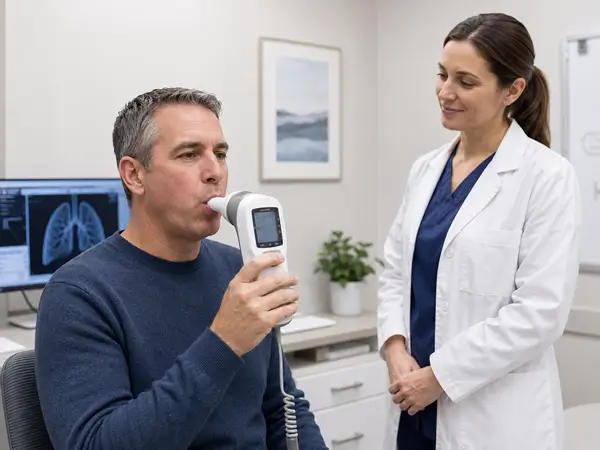
A fractional exhaled nitric oxide test, commonly called a FeNO test, measures the amount of nitric oxide in the air you breathe out. The result can provide information about certain types of inflammation inside the airways.
NOVA Pulmonary Critical Care and Sleep Associates provides FeNO testing and professional interpretation of FeNO test results at our Vienna, Virginia office. Our pulmonary specialists consider your FeNO level together with your symptoms, medical history, medication use, physical examination, and other pulmonary test results.
A FeNO number should not be interpreted by itself. The American Thoracic Society describes FeNO as an additional clinical measurement that should be considered alongside a patient’s history, examination, and lung-function assessment.
NOVA Pulmonary Critical Care and Sleep Associates
📍 Vienna Office
124 Park Street SE, Suite 203
Vienna, VA 22180
Map it
📞 571-367-0000
Office Hours:
Mon – Fri: 9:00AM – 5:00PM
Sat & Sun: Closed
Schedule FeNO testing in Vienna, VA
What Does a FeNO Test Measure?
FeNO stands for fractional exhaled nitric oxide. Nitric oxide is naturally present in exhaled breath, but certain types of airway inflammation can cause the level to increase.
FeNO testing is especially useful for identifying inflammation associated with eosinophilic or Type 2 airway inflammation, which is present in many—but not all—people with asthma.
The result is reported in parts per billion, abbreviated as ppb.
FeNO testing may help your pulmonologist:
- Evaluate airway inflammation
- Support an asthma diagnosis
- Estimate whether inflammation may respond to corticosteroid treatment
- Monitor changes in airway inflammation
- Evaluate asthma that is difficult to control
- Compare your current result with earlier measurements
- Decide whether additional pulmonary testing may be appropriate
FeNO can support an asthma evaluation, but an elevated result is not conclusive proof of asthma, and a low result does not automatically rule asthma out.
What Is Considered a Low, Intermediate or High FeNO Result?
The following ranges are general American Thoracic Society interpretation guidelines for adults. Your pulmonologist may interpret your result differently depending on your symptoms, current treatment, previous results, allergies, smoking history, and other clinical factors.
Low FeNO Result: Less Than 25 ppb
An adult FeNO result below 25 ppb generally suggests that eosinophilic airway inflammation is less likely at the time of testing. It may also suggest that respiratory symptoms are less likely to respond to an increase in corticosteroid treatment.
A low result does not necessarily mean that your lungs are healthy or that asthma is absent. Some patients have asthma that is not associated with elevated eosinophilic inflammation. FeNO levels may also be lower in people who are already taking inhaled corticosteroids or who currently smoke.
When symptoms continue despite a low FeNO result, your provider may evaluate other possible causes, such as:
- Non-eosinophilic asthma
- COPD
- Bronchiectasis
- Vocal cord dysfunction
- Gastroesophageal reflux
- Rhinosinusitis or postnasal drainage
- Cardiac conditions
- Anxiety-related breathing symptoms
- Post-viral airway sensitivity
Your pulmonologist may recommend spirometry, pulmonary function testing, imaging, medication review, or another evaluation based on your symptoms.
Intermediate FeNO Result: 25 to 50 ppb
An adult FeNO result between 25 and 50 ppb falls into an intermediate range. These results require careful interpretation because the significance can vary considerably from one patient to another.
Your pulmonologist may consider:
- Whether you have coughing, wheezing or shortness of breath
- Whether you have already been diagnosed with asthma
- Whether you currently use an inhaled corticosteroid
- Whether the result has increased or decreased
- Your exposure to allergens
- Your inhaler technique and medication consistency
- Your spirometry and pulmonary function results
- Whether you have recently experienced a respiratory illness
An intermediate result does not provide a simple positive-or-negative answer. The clinical context and changes over time may be more useful than the single number alone.
High FeNO Result: Greater Than 50 ppb
A FeNO result above 50 ppb in an adult generally suggests that eosinophilic airway inflammation is more likely. In a patient who is experiencing respiratory symptoms, it may also indicate a greater likelihood that the inflammation will respond to corticosteroid treatment.
However, a high result does not automatically mean that a patient has asthma or that medication should be increased. A pulmonologist must consider the result together with symptoms and other test findings.
In someone already being treated for asthma, persistently elevated FeNO may be associated with:
- Continued airway inflammation
- Ongoing allergen exposure
- Inconsistent use of prescribed medication
- Incorrect inhaler technique
- Difficulty delivering medication into the airways
- A treatment plan that requires reassessment
- An individual baseline that naturally remains elevated
Treatment should not be changed based only on an online interpretation or a single FeNO number.
Does a High FeNO Result Mean You Have Asthma?
Not necessarily. An elevated FeNO result can support an asthma diagnosis when it is consistent with symptoms such as wheezing, coughing, chest tightness, or shortness of breath. However, FeNO testing does not diagnose asthma on its own.
A comprehensive asthma evaluation may include:
- Review of symptoms and medical history
- Physical examination
- Spirometry
- Bronchodilator testing
- Complete pulmonary function testing
- Allergy or blood testing when appropriate
- Evaluation of treatment response
- FeNO testing
Some patients with asthma have normal or low FeNO levels, particularly when their asthma is not driven by eosinophilic inflammation or when they are already taking anti-inflammatory medication. The ATS therefore describes elevated FeNO as supportive rather than conclusive evidence of asthma.
Can You Have Asthma with a Low FeNO Result?
Yes. Asthma is not one single type of airway disease. Some patients have asthma with eosinophilic inflammation, while others have a different inflammatory pattern.
A low FeNO result may indicate that eosinophilic inflammation is less likely, but it does not exclude:
- Non-eosinophilic asthma
- Exercise-induced symptoms
- Asthma controlled by current medication
- Intermittent asthma
- Another respiratory condition causing similar symptoms
This is why FeNO testing is often considered alongside spirometry and other pulmonary assessments.
FeNO Testing Compared with Spirometry
FeNO testing and spirometry measure different aspects of respiratory health.
FeNO testing evaluates a biological marker associated with certain types of airway inflammation.
Spirometry measures how much air you can exhale and how quickly you can move air out of your lungs.
A patient may have elevated airway inflammation even when spirometry appears relatively normal. Conversely, abnormal spirometry may be caused by a condition that does not produce a high FeNO result.
Using the tests together can provide a more complete picture than either test alone. NOVA Pulmonary’s current Vienna FeNO service explains that FeNO may be performed with pulmonary function testing as part of a broader lung evaluation.
Why Previous FeNO Results Matter
FeNO levels can change over time. Comparing your current result with your previous measurements may help your provider understand whether airway inflammation is improving, worsening, or remaining stable.
The ATS suggests that for measurements above 50 ppb, a change greater than approximately 20% may be clinically meaningful. For results below 50 ppb, a change greater than approximately 10 ppb may be meaningful. These are general guides and must still be interpreted in context.
A downward trend may occur after effective anti-inflammatory treatment. A rising or persistently elevated result may lead your provider to review:
- Current respiratory symptoms
- Medication adherence
- Inhaler technique
- Allergen exposure
- Recent illnesses
- Changes in treatment
- The possibility of another condition
Never stop, reduce, or increase an asthma medication based solely on a FeNO result without speaking with your healthcare provider.
Factors That Can Affect FeNO Test Results
FeNO levels can be influenced by more than airway inflammation. Factors that your pulmonologist may consider include:
Asthma Medications
Inhaled or oral corticosteroids can reduce FeNO levels. Tell your provider which medications you use, how frequently you use them, and when you last took them.
Do not stop a prescribed medication before testing unless your provider has specifically instructed you to do so.
Smoking
Current smoking may reduce FeNO levels and can make interpretation more complicated.
Allergies and Allergen Exposure
Allergic sensitization and continued exposure to an allergen may contribute to elevated FeNO levels, even when respiratory symptoms are limited.
Age and Physical Characteristics
Age, height, atopic status, and other individual characteristics can influence FeNO measurements.
Testing Technique
Breathing flow, equipment, measurement technique, and nasal-air contamination can affect the reading. Standardized testing procedures help produce more reliable results.
The ATS recommends that clinicians consider smoking, anti-inflammatory medications, age, allergen exposure, measurement technique, and other confounding factors when interpreting FeNO.
What Happens After Your FeNO Test?
FeNO results are generally available during the appointment. Your pulmonologist will explain your result in the context of your symptoms and other clinical information.
Depending on the findings, the next step may include:
- No immediate change in treatment
- Additional pulmonary testing
- Spirometry or complete pulmonary function testing
- Review of inhaler technique
- Review of asthma medication use
- Evaluation of possible allergy triggers
- Monitoring with repeat FeNO testing
- Assessment for another cause of respiratory symptoms
- An individualized asthma-management plan
A result should guide a clinical conversation rather than be viewed as a stand-alone diagnosis.
Questions to Ask About Your FeNO Results
Consider asking your pulmonologist:
- Is my FeNO level low, intermediate, or high?
- How does this result relate to my symptoms?
- Does my FeNO result support an asthma diagnosis?
- Could my current medication have affected the result?
- How does the result compare with my previous test?
- Do I need spirometry or another pulmonary test?
- Should my inhaler technique be reviewed?
- When should FeNO testing be repeated?
- Could allergies or another condition be affecting my result?
FeNO Test Results and Asthma Monitoring
For patients with established asthma, FeNO testing may be used as one part of ongoing monitoring. The 2021 ATS clinical-practice guideline supports using FeNO in addition to usual care when asthma treatment is being considered, while emphasizing that it should complement—not replace—standard clinical assessment.
Your provider may look at your FeNO trend together with:
- Frequency of symptoms
- Nighttime awakenings
- Rescue-inhaler use
- Asthma flare-ups
- Activity limitations
- Spirometry results
- Medication response
- Side effects and treatment adherence
FeNO Testing and Results Interpretation in Vienna, VA
NOVA Pulmonary Critical Care and Sleep Associates provides pulmonary evaluation, FeNO testing, spirometry, pulmonary function testing, and asthma care at its Vienna office.
Our pulmonary specialists evaluate the complete clinical picture rather than relying on a single number. Patients experiencing chronic coughing, wheezing, chest tightness, shortness of breath, or asthma that is difficult to control may benefit from a professional pulmonary evaluation.
Frequently Asked Questions About FeNO Test Results
What is a normal FeNO test result?
There is no single result that is normal for every person. For adults, the American Thoracic Society generally considers less than 25 ppb a low result, 25 to 50 ppb an intermediate result, and greater than 50 ppb a high result. Your result must be interpreted alongside your symptoms, medical history, medications, and other test findings.
What does a high FeNO result mean?
A high FeNO result may indicate eosinophilic airway inflammation. In a symptomatic patient, it may also suggest that the inflammation is more likely to respond to corticosteroid treatment. It does not diagnose asthma or determine treatment by itself.
Does a low FeNO result rule out asthma?
No. Some forms of asthma do not produce elevated FeNO levels. Asthma medication and smoking may also lower the measurement. Your pulmonologist may use spirometry and other testing to further evaluate your symptoms.
Can asthma medication change my FeNO result?
Yes. Inhaled and oral corticosteroids may lower FeNO levels. Tell your provider about all medications you use, but do not stop prescribed treatment unless specifically instructed.
Why is my FeNO result still high while taking asthma medication?
Possible explanations may include ongoing allergen exposure, missed medication, difficulty using the inhaler correctly, inadequate medication delivery, continuing inflammation, or an individually elevated baseline. Your pulmonologist will review the result before recommending any change.
Is FeNO testing the same as a pulmonary function test?
No. FeNO measures a marker associated with airway inflammation. Pulmonary function testing measures airflow, lung volume, and other aspects of lung function. The tests may be used together.
Why might my pulmonologist repeat the FeNO test?
Repeat testing allows your provider to compare results over time. A trend may provide more useful information than one isolated measurement and may help assess changes in airway inflammation.
How quickly will I receive my FeNO results?
FeNO results are typically available immediately after the breathing test and can usually be discussed during the same appointment.
Where can I have FeNO testing in Vienna, Virginia?
NOVA Pulmonary provides FeNO testing at 124 Park Street SE, Suite 203, Vienna, VA 22180.
Office Locations
Conveniently located near you in Dulles, Leesburg, (Loudoun County) and Vienna, (Fairfax County), VA
NOVA Pulmonary – Dulles
24430 Stone Springs Boulevard
Suite 550
Dulles, VA 20166
NOVA Pulmonary – Lansdowne
19415 Deerfield Avenue
Suite 301
Lansdowne, VA 20176
Meet the team at NOVA Pulmonary Critical Care and Sleep Associates

Dr. Aditya N Dubey, M.D, F.C.C.P. – Founder
Specialty:
Pulmonary, Critical Care and Sleep Medicine
Board Certified by American Board of Internal Medicine in the Subspecialities of Pulmonary Medicine, Critical Care Medicine and Sleep Medicine. Learn more about Dr. Dubey

Dr. Petra Thomas, M.D.
Specialty:
Pulmonary Medicine
Board Certified by American Board of Internal Medicine in the Subspecialities of Pulmonary Medicine. Learn more about Dr. Thomas

Dr. Esha Kapania, M.D.
Specialty:
Pulmonary Medicine
Board Certified by American Board of Internal Medicine in the Subspecialities of Pulmonary Medicine. Learn more about Dr. Kapania

Dr. Arman Murabia, M.D.
Specialty:
Pulmonary, Critical Care and Sleep Medicine
Board Certified by American Board of Internal Medicine in the Subspecialities of Pulmonary Medicine, Critical Care Medicine and Sleep Medicine. Learn more about Dr. Murabia

Dr. Zara Martirosyan, MD
Specialty:
Sleep Medicine & Internal Medicine Specialist
Board-certified physician in both Sleep medicine and Internal medicine. Learn more about Dr. Martirosyan

Rebekah Lee, AGNP-C, Lead APP
Nurse Practitioner. Learn more about Rebekah Lee

Paulos Abebe PA-C
Physician Assistant Learn more about Paulos Abebe PA-C

Katie Cameron, PA
Physician Assistant Learn more about Katie Cameron, PA-C