If you’ve been told you might have sleep apnea, your next question is often, “Do I need a home sleep study or an overnight sleep study in a sleep lab?” The answer depends on your symptoms, overall health, and what your sleep specialist is trying to diagnose.
At Nova Pulmonary and Sleep, patients throughout Vienna, Leesburg, South Riding, Ashburn, Broadlands, Brambleton, Fairfax, Tysons Corner, Chantilly, and Purcellville, VA receive comprehensive sleep disorder evaluations. Whether you’re dealing with loud snoring, daytime fatigue, or suspected obstructive sleep apnea, understanding your testing options can help you take the next step toward better sleep and better health.
Why Sleep Studies Matter
Sleep disorders affect millions of Americans, yet many remain undiagnosed. Obstructive sleep apnea (OSA) is one of the most common conditions, occurring when the airway repeatedly narrows or closes during sleep and interrupts breathing.
Left untreated, sleep apnea has been associated with:
- High blood pressure
- Heart disease
- Stroke
- Type 2 diabetes
- Excessive daytime sleepiness
- Poor concentration
- Increased accident risk
A sleep study provides objective information about your breathing, oxygen levels, heart rate, and sleep patterns, allowing a sleep specialist to determine whether you have sleep apnea or another sleep disorder.
What Is a Home Sleep Study?
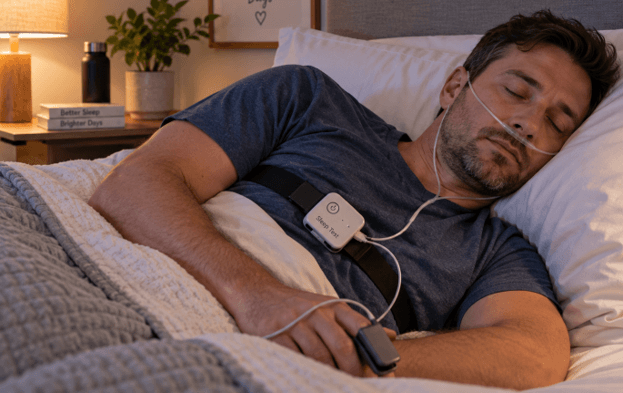
A home sleep study, also called a Home Sleep Apnea Test (HSAT), allows you to complete testing in your own bed.
The equipment is typically portable and measures:
- Breathing effort
- Airflow
- Blood oxygen levels
- Heart rate
- Snoring
- Body position
Unlike laboratory testing, most home studies do not measure brain activity or distinguish between different sleep stages.
According to the American Academy of Sleep Medicine (AASM), home sleep apnea testing is appropriate for adults with a high likelihood of moderate to severe obstructive sleep apnea and without significant medical complications.
Benefits of a Home Sleep Study
Many patients appreciate the convenience of home testing.
Advantages include:
- Sleeping in a familiar environment
- Greater convenience
- No overnight stay in a sleep center
- Usually lower overall cost
- Faster scheduling in many cases
For otherwise healthy adults with classic sleep apnea symptoms, home testing often provides sufficient information to begin treatment.
Limitations of Home Sleep Studies
Although home testing works well for many patients, it is not the best choice for everyone.
A home sleep study may:
- Miss milder cases of sleep apnea
- Fail to detect other sleep disorders
- Produce incomplete data if sensors become displaced
- Provide limited information about sleep quality
Patients with complex medical conditions, chronic lung disease, certain neurological disorders, or suspected central sleep apnea often require more comprehensive testing.
This is where an experienced pulmonologist and sleep physician becomes especially valuable when determining the most appropriate test.
What Is an In-Lab Sleep Study?
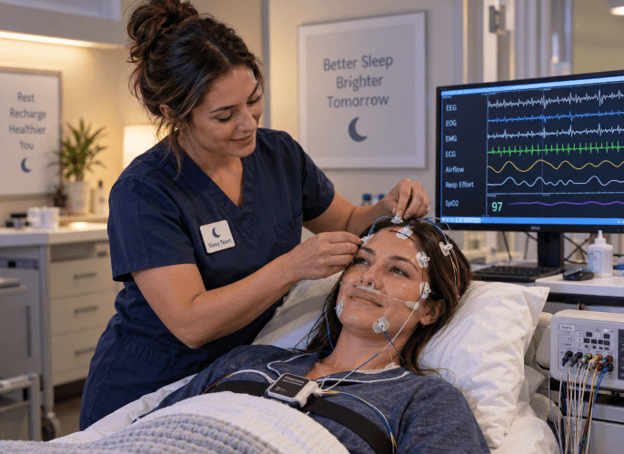
An in-lab sleep study, also known as polysomnography, is performed overnight in a dedicated sleep laboratory under professional supervision.
During the study, multiple sensors monitor:
- Brain waves (EEG)
- Eye movements
- Muscle activity
- Heart rhythm
- Breathing
- Oxygen levels
- Leg movements
- Body position
- Sleep stages
Because technicians monitor the study throughout the night, they can adjust sensors if necessary and collect more complete data than home testing allows.
Benefits of an In-Lab Sleep Study
An overnight sleep study provides the most detailed picture of your sleep.
Benefits include:
- Highest diagnostic accuracy
- Evaluation for multiple sleep disorders
- Continuous professional monitoring
- Better detection of mild or unusual sleep disorders
- Ability to diagnose central sleep apnea, narcolepsy, periodic limb movement disorder, and parasomnias
Studies published in Chest have shown that laboratory polysomnography remains the diagnostic reference standard because it records sleep stages alongside respiratory events, allowing more comprehensive evaluation than portable testing.
Limitations of In-Lab Testing
Although highly accurate, laboratory testing isn’t always necessary.
Potential drawbacks include:
- Overnight stay away from home
- Higher cost
- Longer scheduling times in some regions
- Some patients sleep differently in an unfamiliar environment
Fortunately, many patients still obtain accurate results despite sleeping somewhat differently during their study.
Home Sleep Study vs In-Lab Sleep Study
| Feature | Home Sleep Study | In-Lab Sleep Study |
| Location | Your home | Sleep laboratory |
| Comfort | Familiar environment | Clinical setting |
| Monitored by technician | No | Yes |
| Sleep stages measured | Usually no | Yes |
| Detects multiple sleep disorders | Limited | Yes |
| Best for uncomplicated sleep apnea | Yes | Yes |
| Best for complex sleep disorders | No | Yes |
Which Patients Benefit Most from Home Testing?
Home sleep studies are often recommended for adults who:
- Snore loudly
- Have witnessed pauses in breathing
- Experience excessive daytime sleepiness
- Wake with headaches
- Have obesity or other common sleep apnea risk factors
- Have uncomplicated suspected obstructive sleep apnea
Your sleep specialist will review your symptoms and medical history before deciding whether home testing is appropriate.
When Is an In-Lab Sleep Study Recommended?
An overnight laboratory study may be recommended if you:
- Have significant lung disease
- Have COPD or advanced asthma
- Have heart failure
- Have neurological disorders
- Have suspected central sleep apnea
- Previously had an inconclusive home study
- May have multiple sleep disorders
Patients seeing a lung specialist for chronic respiratory conditions may benefit from the more comprehensive evaluation available in a sleep laboratory.
Research published in the New England Journal of Medicine demonstrated that carefully selected patients with uncomplicated obstructive sleep apnea can often be effectively diagnosed and managed using home sleep testing combined with specialist evaluation, while more complex cases continue to benefit from laboratory testing.
How Nova Pulmonary and Sleep Helps Patients
Choosing the right sleep study is only one part of diagnosing sleep disorders.
At Nova Pulmonary and Sleep, patients receive:
- Comprehensive sleep evaluations
- Home sleep apnea testing when appropriate
- Referrals for in-lab polysomnography when needed
- Diagnosis of obstructive sleep apnea
- Personalized treatment recommendations
- Long-term follow-up care
As both a pulmonologist and sleep specialist, the practice also evaluates related conditions including asthma, COPD, chronic cough, shortness of breath, lung nodules, and lung cancer, helping patients receive coordinated respiratory and sleep care.
Common Questions
Is A Home Sleep Study As Accurate As A Lab Study?
For adults with uncomplicated suspected obstructive sleep apnea, home testing is considered accurate when a qualified sleep physician orders and interprets it. However, it is not suitable for every patient.
Can A Home Sleep Study Diagnose Every Sleep Disorder?
No. Home testing is primarily designed to diagnose obstructive sleep apnea and cannot reliably diagnose many other sleep conditions.
Will Insurance Cover My Sleep Study?
Many insurance plans cover medically necessary home or laboratory sleep studies. Coverage varies by policy.
What Happens After My Results?
Your sleep physician reviews the findings, discusses your diagnosis, and develops an individualized treatment plan that may include CPAP therapy, oral appliances, lifestyle modifications, or additional evaluation.

Take the First Step Toward Better Sleep
Never ignore persistent snoring, excessive fatigue, or suspected sleep apnea. Whether you need a home sleep study or an overnight laboratory evaluation, choosing the right test is the first step toward better sleep and improved long-term health.
If you’re looking for an experienced sleep specialist, pulmonologist, or lung specialist in Vienna, Leesburg, Ashburn, Fairfax, Tysons Corner, Chantilly, Purcellville, South Riding, Broadlands, or Brambleton, Nova Pulmonary and Sleep can help.
Visit http://www.novapulmonary.com to schedule an evaluation and learn which sleep study is right for you.