FeNO Asthma Testing in Vienna, VA
If you are experiencing shortness of breath, wheezing, chronic coughing, or chest tightness, it may be a sign of airway inflammation or asthma. Identifying the underlying cause of these symptoms is an important step toward getting the right treatment and improving your breathing. One advanced diagnostic tool that can help physicians evaluate airway inflammation is Fractional Exhaled Nitric Oxide (FeNO) testing, a simple and non-invasive breathing test that measures nitric oxide levels in your breath.
At Nova Pulmonary Critical Care and Sleep Associates, our pulmonary specialists offer FeNO testing in Vienna, Virginia to help diagnose asthma and assess airway inflammation. This quick and painless test provides valuable insight into lung health and helps determine whether anti-inflammatory asthma treatments may be effective. By using advanced diagnostic tools like FeNO testing, our team can create personalized treatment plans to help patients throughout Vienna and Northern Virginia breathe easier and gain better control of their respiratory health.
NOVA Pulmonary Critical Care and Sleep Associates
📍 Vienna Office
124 Park Street SE, Suite 203
Vienna, VA 22180
Map it
📞 571-367-0000
Office Hours:
Mon – Fri: 9:00AM – 5:00PM
Sat & Sun: Closed
What Is FeNO Testing?
Fractional exhaled nitric oxide (FeNO) testing is a simple breathing test that measures airway inflammation. People with certain types of asthma often have elevated nitric oxide levels in their breath because inflamed airway cells release this gas.
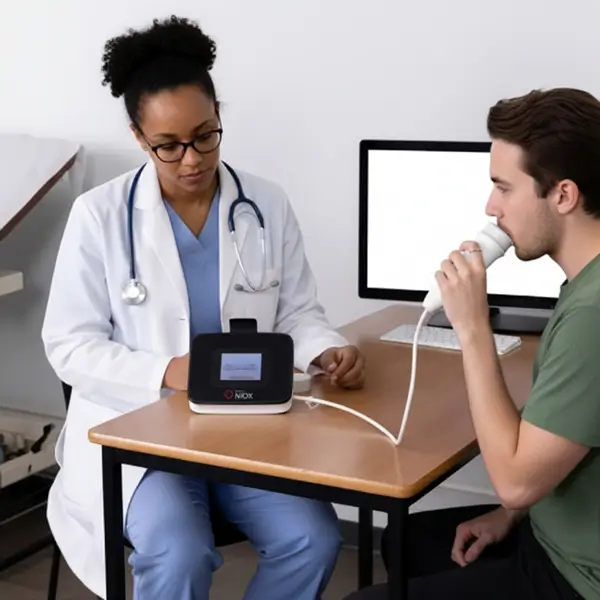
During the test, you breathe slowly and steadily into a handheld device that measures nitric oxide concentration. The process takes only a few minutes and does not involve needles, medications, or radiation.
FeNO testing provides valuable information that helps physicians determine:
- Whether airway inflammation is present
- If asthma is likely causing symptoms
- Whether inhaled corticosteroid medications may help
- How well current asthma treatments are working
Because FeNO specifically measures eosinophilic airway inflammation, it is particularly useful for identifying patients who will respond well to anti-inflammatory asthma medications.
Why FeNO Testing Is Important for Asthma Diagnosis?
Asthma can sometimes be difficult to diagnose because symptoms overlap with other respiratory conditions. Traditional breathing tests measure airflow but may not always detect inflammation in the airways.
FeNO testing adds an important layer of diagnostic information by directly measuring airway inflammation. This allows physicians to identify asthma earlier and develop more targeted treatment plans.
Benefits of FeNO testing include:
- More accurate asthma diagnosis
- Identification of inflammation even when lung function appears normal
- Reduced trial-and-error when prescribing medications
- Improved monitoring of asthma control
By combining FeNO testing with pulmonary function testing, doctors can better understand both airway inflammation and lung function.
Conditions FeNO Testing Helps Evaluate
FeNO testing is most commonly used for patients with suspected or known asthma, but it can also provide helpful insights for other respiratory conditions.
Your provider may recommend FeNO testing if you have:
- Persistent coughing or wheezing
- Shortness of breath during exercise
- Difficulty controlling asthma symptoms
- Frequent asthma flare-ups
- Symptoms that do not improve with treatment
The test is especially helpful for determining whether symptoms are related to eosinophilic airway inflammation, a common asthma subtype that responds well to steroid therapy.
How FeNO Testing Helps Guide Asthma Treatment
One of the most important benefits of FeNO testing is its ability to help physicians personalize asthma treatment.
FeNO results help doctors determine:
Whether inhaled corticosteroids will work
High nitric oxide levels often indicate inflammation that responds well to steroid medications.
If asthma medication is working
Lower FeNO levels after treatment usually indicate that airway inflammation is improving.
If medication adjustments are needed
Persistently elevated levels may indicate the need for a different treatment strategy.
If biologic therapies may be beneficial
Patients with severe inflammation may qualify for advanced biologic medications designed for certain asthma types.
By measuring airway inflammation directly, FeNO testing helps physicians avoid unnecessary medications and focus on treatments that work best for each patient.
FeNO Testing at Nova Pulmonary
At Nova Pulmonary Critical Care and Sleep Associates, FeNO testing is often performed together with pulmonary function testing to provide a comprehensive assessment of lung health.
Our pulmonary specialists use FeNO testing to:
- Diagnose asthma more accurately
- Evaluate unexplained respiratory symptoms
- Monitor asthma control over time
- Optimize medication therapy
This advanced diagnostic approach helps patients achieve better asthma control, fewer flare-ups, and improved breathing.
Patients from across Vienna, Fairfax County, Tysons, McLean, Reston, and Arlington visit our clinic for specialized pulmonary testing and personalized asthma care.
How to Prepare for FeNO Testing
FeNO testing is quick and easy, but following a few simple guidelines can help ensure accurate results.
Patients may be advised to:
- Avoid eating or drinking for 1 hour before the test
- Avoid exercise for at least 1 hour before testing
- Avoid smoking prior to the test
- Inform your provider about any asthma medications you are taking
Your provider will give you specific instructions depending on your medical history and symptoms.
The test itself usually takes less than five minutes and results are available immediately.
Benefits of FeNO Testing for Patients
FeNO testing offers several advantages for patients with asthma or respiratory symptoms.
Key benefits include:
- Non-invasive and painless
- Fast results during your appointment
- Improved accuracy in asthma diagnosis
- Personalized treatment plans
- Better monitoring of airway inflammation
With this advanced testing technology, patients can receive more precise care and better long-term asthma management.
Schedule FeNO Testing in Vienna, VA
If you have asthma symptoms or difficulty controlling your breathing, FeNO testing may help identify the cause and guide treatment.
The pulmonary specialists at Nova Pulmonary Critical Care and Sleep Associates provide advanced diagnostic testing for asthma and airway inflammation to help patients breathe easier and improve lung health.
Contact our office today to schedule an evaluation and learn whether FeNO testing is right for you.
FAQ – FeNO Testing for Asthma
What does FeNO testing measure?
FeNO testing measures the amount of nitric oxide gas in your breath. Elevated levels indicate inflammation in the airways, which is commonly associated with certain types of asthma.
Is FeNO testing painful?
No. FeNO testing is completely non-invasive and painless. Patients simply breathe slowly into a handheld device for a few seconds.
How long does FeNO testing take?
The entire test typically takes only a few minutes, and results are usually available immediately during your appointment.
Who should have FeNO testing?
FeNO testing may be recommended for patients with suspected asthma, persistent cough, wheezing, or difficulty controlling asthma symptoms.
Can FeNO testing diagnose asthma?
FeNO testing helps support an asthma diagnosis by measuring airway inflammation, but it is typically used alongside other tests such as pulmonary function testing.
Do I need to prepare for FeNO testing?
Patients may be asked to avoid eating, smoking, or exercising for about an hour before the test to ensure accurate results.
How often should FeNO testing be repeated?
Some patients may have repeat testing during follow-up visits to monitor airway inflammation and evaluate how well asthma treatments are working.
Directions & Parking Information
Our Vienna office is located on Park Street SE near the Vienna Community Center and historic downtown Vienna.
Free parking available near the building
Elevator access to Suite 203
Easily accessible from Route 123 and I-66
Minutes from Tysons Corner
If you need assistance locating our office, please call and our staff will guide you.
Frequently Asked Questions – COPD & Asthma Care in Vienna, VA
What is the difference between COPD and asthma?
COPD (Chronic Obstructive Pulmonary Disease) and asthma are both chronic lung conditions that affect breathing. COPD is usually caused by long-term exposure to lung irritants such as cigarette smoke and tends to worsen over time. Asthma is caused by airway inflammation and can be triggered by allergens, exercise, cold air, or respiratory infections. Both conditions require proper diagnosis and management by a pulmonary specialist.
What are the early symptoms of COPD?
Early symptoms of COPD often include shortness of breath during activity, persistent coughing, wheezing, chest tightness, and increased mucus production. Some patients also experience frequent respiratory infections or fatigue. Early diagnosis and treatment can help slow the progression of COPD.
What are the most common asthma symptoms?
Asthma symptoms may include wheezing, shortness of breath, coughing (especially at night or early morning), and chest tightness. Symptoms may worsen when exposed to allergens, smoke, pollution, cold air, or during exercise.
How are COPD and asthma diagnosed?
Pulmonary specialists diagnose COPD and asthma using a combination of medical history, physical examination, and lung function testing. Common diagnostic tests include spirometry, pulmonary function testing (PFT), and imaging studies to evaluate lung health and breathing capacity.
What treatments are available for COPD and asthma?
Treatment depends on the severity of the condition but may include inhalers, bronchodilators, corticosteroid medications, nebulizer treatments, pulmonary rehabilitation, and lifestyle modifications such as smoking cessation and avoiding triggers.
When should I see a pulmonologist for breathing problems?
You should see a pulmonologist if you experience persistent coughing, wheezing, shortness of breath, frequent respiratory infections, or difficulty breathing during normal activities. Early evaluation can help diagnose COPD, asthma, or other lung conditions.
Can COPD or asthma be cured?
Neither COPD nor asthma currently has a cure, but both conditions can be effectively managed with proper medical treatment and lifestyle adjustments. Many patients are able to control symptoms and maintain a normal, active lifestyle with the right care plan.
Where can I receive COPD and asthma care in Vienna, VA?
NOVA Pulmonary provides comprehensive COPD and asthma care in Vienna, VA, including pulmonary testing, diagnosis, treatment plans, and long-term respiratory management.
Schedule Your Appointment Today
If you are experiencing symptoms of sleep apnea, our Vienna sleep specialists are here to help.
Call today or schedule online to begin your evaluation
Office Locations
Conveniently located near you in Dulles, Leesburg, (Loudoun County) and Vienna, (Fairfax County), VA
NOVA Pulmonary – Dulles
24430 Stone Springs Boulevard
Suite 550
Dulles, VA 20166
NOVA Pulmonary – Lansdowne
19415 Deerfield Avenue
Suite 301
Landsdowne, VA 20176
NOVA Pulmonary Critical Care and Sleep Associates is committed to providing excellent care in all aspects of Pulmonary Medicine and Sleep Disorders. With offices located in Lansdowne and Dulles, South Riding, we offer care for the entire Northern Virginia region, serving locations from Chantilly, Fairfax, Vienna, Centreville, Manassas, Gainesville to Reston, Sterling, Leesburg, Ashburn, Brambleton, Purcellville and more.
Meet the team at NOVA Pulmonary Critical Care and Sleep Associates

Dr. Aditya N Dubey, M.D, F.C.C.P. – Founder
Specialty:
Pulmonary, Critical Care and Sleep Medicine
Board Certified by American Board of Internal Medicine in the Subspecialities of Pulmonary Medicine, Critical Care Medicine and Sleep Medicine. Learn more about Dr. Dubey

Dr. Petra Thomas, M.D.
Specialty:
Pulmonary Medicine
Board Certified by American Board of Internal Medicine in the Subspecialities of Pulmonary Medicine. Learn more about Dr. Thomas

Dr. Arman Murabia, M.D.
Specialty:
Pulmonary, Critical Care and Sleep Medicine
Board Certified by American Board of Internal Medicine in the Subspecialities of Pulmonary Medicine, Critical Care Medicine and Sleep Medicine. Learn more about Dr. Murabia

Dr. Zara Martirosyan, MD
Specialty:
Sleep Medicine & Internal Medicine Specialist
Board-certified physician in both Sleep medicine and Internal medicine. Learn more about Dr. Martirosyan

Rebekah Lee, AGNP-C, Lead APP
Nurse Practitioner. Learn more about Rebekah Lee

Paulos Abebe PA-C
Physician Assistant Learn more about Paulos Abebe PA-C

Katie Cameron, PA
Physician Assistant Learn more about Katie Cameron, PA-C

Christine Amorosi, AGNP-C
Nurse Practitioner. Learn more about Christine Amorosie